If you are in crisis now
Call or text 988 in the United States, or chat at https://988lifeline.org.
You do not have to be “at the edge” to reach out. Feeling overwhelmed is reason enough.
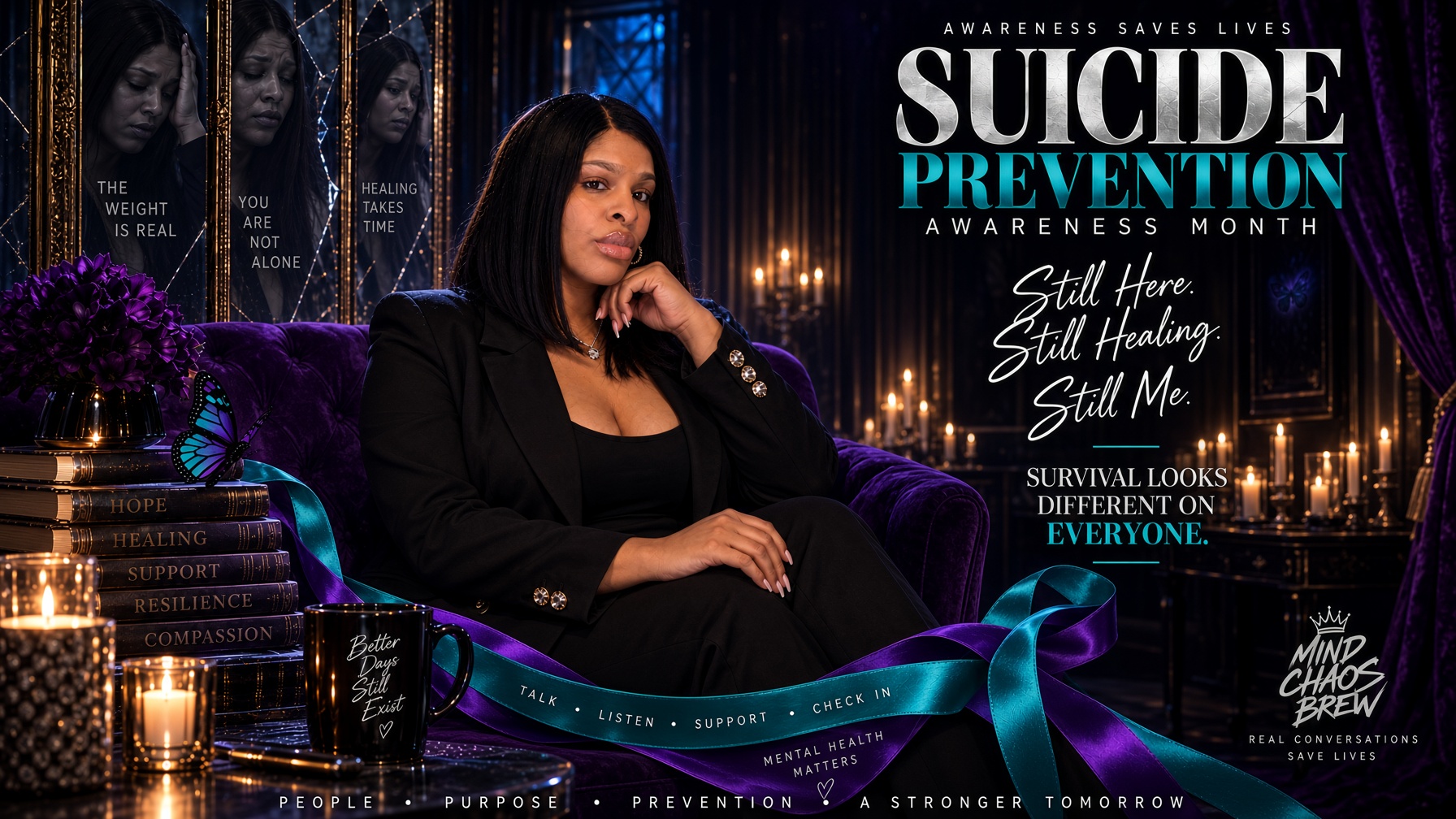
STILL HERE. STILL HEALING. STILL US
A note for the working class as the light changes
The air is shifting. Mornings are cooler. The sun clocks out earlier. Summer’s loose promise that it will get easier starts to thin, and a lot of people who keep this country running feel it in their chest before they can name it.
If you are clocking in tired, stretching a paycheck across rent, groceries, gas, and a student loan that never blinks, this is for you. If you did everything you were told (stay in school, get the credential, be reliable) and the world still pays you like your time is cheap while everything else costs more, this is for you.
You are not weak for feeling heavy. The weight is real.
THE SQUEEZE IS NOT JUST "IN YOUR HEAD"
Suicide took 48,824 lives in the United States in 2024. Far more people thought about it: an estimated 14.3 million adults seriously considered suicide that year [1].
Those numbers are not only clinical. They sit inside pay stubs and eviction notices. Research has tied unemployment and underemployment to suicide mortality, not as a slogan, but as a measurable driver of despair. One analysis estimated that labor underutilization accounted for a substantial share of suicides over a multi-year period [2].
“Deaths of despair” research and county-level studies keep finding the same pattern: economic insecurity, job loss, financial shock, and thin safety nets travel with higher midlife mortality [3][4]. Among people who died by suicide with a documented circumstance, job problems (especially unemployment and job stress) show up again and again, and they cluster with financial strain and depressed mood [5].
Education was supposed to be the ladder. For many workers it became a mismatch. Overeducation, meaning more schooling than the job uses, has been linked in multiple studies to more depressive symptoms, especially when unemployment is high and the wage does not match the investment [6][7]. That is not “entitlement.” That is a person who did the assignment and still cannot make rent.
CDC data on working-age suicide also show that some of the highest rates sit in the trades and service worlds many of us come from or work beside: construction, extraction, installation, agriculture, and personal care. Those are places where the body is used up and the conversation about pain is often shut down [8].
Fall makes the math louder. Shorter days. Higher bills on the horizon. Kids back in a routine you cannot afford to miss a day of. The quiet after Labor Day when the “busy season” story ends and the same problems are still sitting on the kitchen table.
A YOUNG MAN WHO RAN OUT OF ROOM
This piece does not invent a tragedy to make a point. It names one family that already chose to speak, so the rest of us stop pretending this only happens to “other people.”
Cameron Haire was 26. He worked. He went back to school for a pharmacy technician diploma because the cost of living had already taught him that hustle without a credential still was not enough. He moved home so his parents could help him finish. His mother later wrote that he thrived in that chapter (learning, getting his license, coming into himself) and then the ground gave way. Depression he had fought on and off deepened. The future he had paid for with time, debt, and hope did not open. On August 11, 2023, Cameron died by suicide [9][10].
His mother’s public words are spare and unbearable: My son is gone. She described a young man who was sweet, sensitive, and trying. Not a headline. A person who needed a system that could hold him when the economy and his mind both closed in.
Cameron is one name. There are others in every city: the graduate sending hundreds of applications; the gold-medalist who cannot land work that matches the degree; the master’s student who feels like a burden because the family is still wiring money. Different zip codes. Same sentence in the chest: I did what I was told, and I am still sinking.
No one dies for a single reason. Mental illness, isolation, shame, access to care, and money braid together. But we do something cruel when we talk only about “personal resilience” and never mention the rent.
He needed a shoulder. Too many people in that spot get a lecture instead.
THE PSYCHOLOGY WE KEEP GETTING WRONG
Hopelessness is not laziness. In the psychology of suicide risk, two feelings show up again and again: I don’t belong, and I am a burden. When those sit on top of pain that feels inescapable, the mind starts treating disappearance as a solution. Academic pressure and the sense of being a disappointment have been shown to feed that “burdensomeness” pathway [11].
At work and at home, we often miss the signs because we are trained to manage performance, not pain.
We see:
the coworker who got quiet
the friend who stopped coming to lunch
the adult child sleeping too much or not at all
the reliable person who starts calling out
the joke that is a little too dark
the sudden “I’m fine, don’t worry about me”
And we file them as attitude, weakness, drama, or a problem to be corrected.
The American Foundation for Suicide Prevention asks us to watch for new or changed talk, behavior, and mood, especially after a loss or a hard change: talking about feeling hopeless, trapped, or a burden; withdrawing; giving things away; sleep that breaks; irritability or a sudden eerie calm [12].
Most people who die by suicide have shown something. We miss it because we are busy, scared of saying the wrong word, or because our culture taught us that a working person’s job is to swallow it.
REACTIVE CULTURE VERSUS SOLUTION BASED CARE
Reactive sounds like:
“Everybody’s tired.”
“You just need to grind.”
“Other people have it worse.”
“Don’t be so negative.”
Writing someone up for the symptom instead of asking about the cause.
Solution-based sounds like:
“I’ve noticed you seem smaller lately. I care about you. Want to talk?”
“Are you thinking about suicide?” asked calmly, directly, without panic. Asking does not plant the idea. It opens a door [13].
“You are not a problem to fix. You are a person I will sit with.”
Helping them connect to 988, a clinic, a union EAP, a pastor, a trusted sibling, and then following up.
The national #BeThe1To steps are simple on purpose: Ask. Be there. Keep them safe. Help them connect. Follow up [13].
September’s Suicide Prevention Awareness Month opens with connection for a reason. SAMHSA’s reminder is almost working-class in its plainness: a check-in, a shared resource, a moment of genuine attention is how communities take care of each other [14].
HOW TO BE A SAFE SPACE FOR SOMEONE WHO IS MELANCHOLY
You do not need a license. You need to stop competing with their pain.
Talk in private. Not in the break room with an audience.
Listen longer than you advise. “That sounds exhausting” is often more useful than a five-step plan.
Don’t steal the story. Don’t one-up. Don’t make it about your worst year unless they ask.
Name the economy without erasing the mind. Both can be true: the system is grinding people down, and depression lies about the future.
Ask the direct question if you are worried. Then stay. Help them call or text 988 together if they will let you.
Offer a specific hand, not a vague “let me know.” “I’m off at 6. I’ll bring food.” “I’ll sit in the parking lot while you go in.” “I’ll text you Thursday.”
Protect their dignity at work. A safe workplace treats a struggling person as a colleague, not a liability. Managers: a quiet conversation beats a public correction.
Survival looks different on everyone. Some people keep the blazer on and the lights on in their eyes. Some people can only do the next hour. Both are still here. Both still count.
IF YOU ARE THE ONE WHO FEELS OUT OF OPTIONS
Read this slowly.
You are not a failed investment. You are not “too educated to be useful” or “not educated enough to matter.” You are a human being in a market that has been asking more and paying less, and your nervous system is responding to a real threat: instability.
Better days still exist. They do not always arrive as a movie ending. Sometimes they arrive as one night of sleep, one bill paid, one person who does not flinch when you tell the truth.
Please do not carry this alone.
HELP FOR YOU AND FOR SOMEONE YOU LOVE
988 Suicide & Crisis Lifeline (U.S.): call, text, or chat 24/7 at https://988lifeline.org. Spanish, Veteran (press 1), and Deaf/Hard of Hearing options are available. You can call because you are anxious about money, lonely, or just need a human voice [15].
Crisis Text Line: text HOME to 741741. https://www.crisistextline.org
Veterans Crisis Line: 988, then press 1, or text 838255. https://www.veteranscrisisline.net
Find treatment: https://findtreatment.gov or call SAMHSA at 1-800-662-HELP (4357)
AFSP warning signs and how to help: https://afsp.org/risk-factors-protective-factors-and-warning-signs/
#BeThe1To, five actions anyone can take: https://www.bethe1to.com/
Outside the United States: https://findahelpline.com
If someone is in immediate danger, call 911 or your local emergency number.
A STRONGER TOMORROW IS BUILT IN SMALL ROOMS
Talk. Listen. Support. Check in.
People. Purpose. Prevention.
If you have a Cameron in your life, the quiet one who did everything right and still looks like the lights went out, do not wait for a perfect speech. Send the text. Pull the chair closer. Say you are not a problem. You are wanted here.
And if you are reading this on your break, in a parked car, or after the kids are finally down: you still belong in the story. Still here. Still healing. Still you.
Mental health matters. Real conversations save lives.
Mind Chaos Brew
Awareness saves lives. Suicide Prevention Awareness Month.
References
[1] Centers for Disease Control and Prevention. Suicide Data and Statistics.
https://www.cdc.gov/suicide/data/index.html
[2] Botha, F., et al. (2023). Unemployment and underemployment are causes of suicide. Science Advances.
https://www.science.org/doi/10.1126/sciadv.adg3758
[3] Economic Insecurity and Deaths of Despair in US Counties.
https://pmc.ncbi.nlm.nih.gov/articles/PMC7212405/
[4] National Academies / NCBI. Suicide, in High and Rising Mortality Rates Among Working-Age Adults.
https://www.ncbi.nlm.nih.gov/books/NBK571939/
[5] Job Problems in Suicide: National Violent Death Reporting System, 2020–2022. American Journal of Preventive Medicine.
https://www.ajpmonline.org/article/S0749-3797(26)00066-8/abstract
[6] Bracke, P., et al. (2013). Overeducation and depressive symptoms: diminishing mental health returns to education. Sociology of Health & Illness.
https://onlinelibrary.wiley.com/doi/10.1111/1467-9566.12039
[7] On the moderation of the relation between overeducation and depressive symptoms through labor market and macro-economic factors. Health & Place.
https://www.sciencedirect.com/science/article/abs/pii/S1353829218308827
[8] CDC. Suicide Rates by Industry and Occupation, United States, 2021.
https://pmc.ncbi.nlm.nih.gov/articles/PMC10727139/
[9] Haire, M. Commentary: Cameron was thriving before his illness made him lose hope. PNI Atlantic News.
https://www.saltwire.com/atlantic-canada/commentary-cameron-was-thriving-before-his-illness-made-him-lose-hope-100959887
[10] Anstey, D. “Nothing left for us”: Graduates face mental anguish with unmet job expectations and student loans. PNI Atlantic News.
https://www.saltwire.com/newfoundland-labrador/nothing-left-for-us-graduates-face-mental-anguish-with-unmet-job-expectations-and-student-loans
[11] Examining the Relationship between Academic Expectations and Suicidal Ideation among College Students in India Using the Interpersonal Theory of Suicide. Archives of Suicide Research.
https://www.tandfonline.com/doi/full/10.1080/13811118.2022.2110026
[12] American Foundation for Suicide Prevention. Risk factors, protective factors, and warning signs.
https://afsp.org/risk-factors-protective-factors-and-warning-signs/
[13] #BeThe1To. Five action steps for communicating with someone who may be suicidal.
https://www.bethe1to.com/
[14] Substance Abuse and Mental Health Services Administration. Suicide Prevention Awareness Month.
https://www.samhsa.gov/about/digital-toolkits/suicide-prevention-month
[15] 988 Suicide & Crisis Lifeline.
https://988lifeline.org
Crisis Text Line: https://www.crisistextline.org
Veterans Crisis Line: https://www.veteranscrisisline.net
SAMHSA treatment locator: https://findtreatment.gov
Find a Helpline (international): https://findahelpline.com
No published comments yet. You can open the conversation.