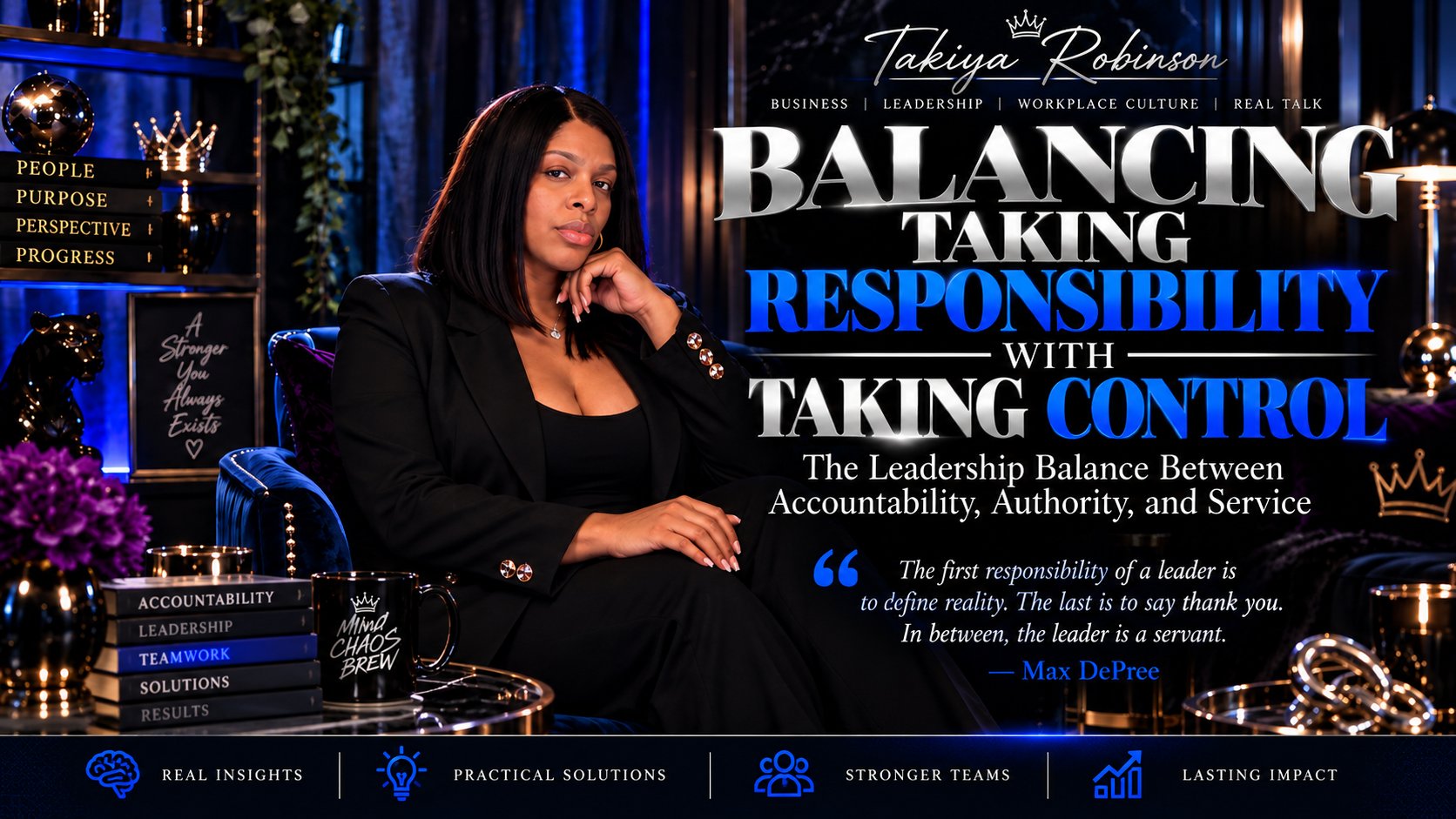
There is a conversation we need to have about responsibility, particularly in workplaces where accountability is frequently discussed but authority, resources, and organizational support are not always distributed equally.
We often hear that everyone must take responsibility. Employees must be accountable for their performance, managers for their teams, and leaders for the overall success of the organization.
Fair enough.
But what happens when someone is held responsible for an outcome they do not have the authority, resources, or ability to control?
And at what point does encouraging accountability become transferring responsibility?
That distinction matters because taking responsibility and taking control are not the same thing.
One is about owning your obligations and actions. The other is about possessing the authority and capacity to influence what happens next.
Healthy organizations understand that both are necessary, but they are not interchangeable.
Leadership Begins With Reality, Not Blame
Business leader and author Max De Pree offered a philosophy that continues to challenge how we understand leadership:
“The first responsibility of a leader is to define reality. The last is to say thank you. In between, the leader is a servant.”
— Max De Pree, Leadership Is an Art (commonly circulated shortened version)
Consider the first part: define reality.
Not define who is at fault.
Not determine who should be more understanding.
Not immediately identify what employees could have done differently.
Define reality.
That means examining the actual conditions within an organization before assigning responsibility for the outcomes those conditions produce.
Are the systems functioning as intended? Are employees receiving adequate training and support? Are staffing levels aligned with operational demands? Are established procedures efficient, or are employees spending unnecessary time compensating for processes that consistently fail?
These are management questions, not simply employee performance questions.
When leaders begin with assumptions about behavior rather than examining evidence, they risk confusing symptoms with causes.
And a problem that is incorrectly diagnosed is unlikely to be effectively resolved.
Accountability Without Authority Creates Frustration
Imagine an employee who discovers a timekeeping discrepancy.
They follow the established reporting procedure, submit the appropriate documentation, notify the responsible department, and wait for resolution.
Days pass. The problem remains.
When they raise the concern again, they are instructed to continue submitting emails or additional documentation.
Technically, the employee has been given a course of action.
But has the underlying problem been addressed?
Not necessarily.
The employee can control whether they report the discrepancy accurately, follow the procedure, and provide the required information.
They cannot necessarily control how quickly another department processes the request, whether the system functions correctly, or whether the organization has allocated sufficient resources to resolve the issue.
An employee can be responsible for initiating a process without being responsible for the organization's ability to complete it.
This does not eliminate individual accountability. Employees who fail to follow procedures or misuse systems should be held accountable based on evidence.
However, the same standard must extend to the systems and departments responsible for supporting them.
Otherwise, accountability becomes a one-directional expectation rather than a shared organizational value.
The Difference Between Responsibility and Control
Responsibility asks: What am I obligated to do?
Control asks: What decisions, resources, and outcomes am I actually empowered to influence?
The distinction becomes especially important in complex organizations, where employees depend on multiple departments to complete even routine tasks.
An individual employee may have control over the accuracy of a submitted request but no control over the software used to process it.
A supervisor may be responsible for team performance but have limited influence over staffing budgets or technical infrastructure.
A workforce management department may be accountable for timely adjustments while operating with insufficient staffing to handle the volume of requests.
These realities can coexist.
Recognizing one department's challenges does not require dismissing another employee's legitimate concerns.
In fact, effective management requires understanding how those challenges interact.
The objective should not be to identify one group that must carry the entire burden. It should be to align responsibilities with the authority, tools, and resources necessary to fulfill them.
Teamwork Is Shared Accountability, Not Shared Blame
Organizations frequently emphasize teamwork, and rightly so.
The actions of one employee or department can influence the performance of others. Excessive administrative work can reduce operational capacity. Inaccurate submissions can create additional processing demands. Delayed corrections can affect employee confidence and satisfaction.
But teamwork should not become an argument for distributing blame without examining the facts.
Suppose a department receives hundreds of adjustment requests daily.
That number may indicate employee errors, inconsistent training, complicated procedures, technical failures, staffing limitations, or some combination of these factors.
The volume tells us that something deserves investigation.
It does not, by itself, explain why the problem exists.
A business-minded approach would begin by categorizing those requests, identifying recurring patterns, measuring processing times, and determining which issues could be prevented through better procedures or automation.
This is the difference between reactive management and continuous improvement.
Reactive management asks employees to keep reporting the same problem.
Continuous improvement asks why the same problem keeps requiring a report.
Teamwork does not mean everyone is responsible for everything. It means everyone understands their responsibilities and how those responsibilities contribute to a functioning organization.
Listening Is an Operational Leadership Skill
Another overlooked element of accountability is communication.
Employees often raise concerns because they are close enough to daily operations to recognize problems that may not be immediately visible to leadership.
Their observations are a form of operational information.
That does not mean every employee interpretation will be correct, or that every proposed solution will be practical.
It does mean those concerns deserve to be understood before they are evaluated.
When a leader interrupts an employee repeatedly, moves immediately into solutions, or redirects the conversation before the concern is fully explained, an opportunity may be lost.
The leader may leave believing the problem has been addressed because advice was provided.
The employee may leave believing the conversation never reached the actual issue.
Both participated in the same meeting, yet they experienced two different outcomes.
This is why listening should not be treated merely as a courtesy.
Listening is part of gathering the information necessary to make sound management decisions.
An effective leader should be willing to ask whether the solution being offered actually addresses the problem being described.
And sometimes that requires resisting the temptation to respond before fully understanding.
Taking Control Means Improving What We Can Influence
There is also a personal responsibility embedded in this discussion.
Recognizing the limitations of our authority should not become an excuse to abandon our agency.
Employees still have choices.
We can communicate clearly, document accurately, follow procedures, recommend improvements, and remain professional when discussing difficult situations.
Managers can examine workflows, clarify expectations, advocate for resources, and create opportunities for feedback.
Senior leadership can establish priorities, allocate resources, evaluate performance measures, and remove unnecessary operational barriers.
Each level has different responsibilities and different degrees of control.
The goal is not to control everything.
The goal is to exercise appropriate control over what falls within our authority while recognizing when a problem requires action from someone else.
This also requires humility. Sometimes our own actions contribute to a problem, and we must be willing to acknowledge that.
Other times, we may be doing everything correctly within a process that needs improvement.
Maturity is recognizing the difference without automatically defending ourselves or blaming someone else.
Servant Leadership Requires More Than Good Intentions
Returning to De Pree's philosophy, the middle of his statement is perhaps the most challenging.
The leader is a servant.
Service in leadership is not simply about being pleasant, approachable, or willing to offer advice.
It involves creating conditions in which other people can perform their responsibilities effectively.
A leader who expects accountability must also consider whether employees have been equipped to meet those expectations.
A leader who promotes teamwork must examine whether departments have the capacity to support one another.
A leader who encourages feedback must be willing to hear information that challenges existing assumptions.
And a leader who asks employees to take ownership must be prepared to demonstrate organizational ownership as well.
This is not about eliminating standards or shielding employees from consequences.
It is about making those standards credible by applying accountability throughout the organization.
Leadership loses credibility when accountability is demanded from those with the least control but treated as optional for those with the greatest authority.
The Final Responsibility: Saying Thank You
De Pree's closing emphasis on gratitude deserves attention, too.
Thank you.
Two simple words that acknowledge the contributions of others.
But appreciation should extend beyond recognizing productivity and celebrating positive performance metrics.
It should also recognize the employees who identify problems, report discrepancies, suggest improvements, and participate in difficult conversations because they care about how an organization operates.
Not every concern is a complaint.
Not every disagreement is resistance.
And not every employee who challenges a process is refusing accountability.
Sometimes the person asking the uncomfortable question is identifying an opportunity the organization has not yet recognized.
Gratitude does not mean every suggestion must be adopted. It means acknowledging the value of participation and communicating what will happen next.
That is how organizations begin to develop trust.
The Balance That Matters
Taking responsibility without taking control can become helplessness.
Attempting to take control without accepting responsibility can become domination.
But balancing the two creates something more productive: accountability grounded in reality.
For employees, that means owning their conduct and obligations without accepting responsibility for organizational decisions beyond their authority.
For managers, it means balancing performance expectations with practical support.
For leadership, it means defining reality accurately, distributing accountability appropriately, and creating systems that allow people to succeed.
And for organizations, it means recognizing that employee morale is influenced not only by the problems people encounter but also by what happens when they make a good-faith effort to resolve them.
The question is not simply, Who should take responsibility?
The better questions are:
Who has the authority to act? What resources are available? What evidence explains the problem? And what needs to change so that the same issue does not continue?
Because accountability without understanding becomes blame.
Control without responsibility becomes power without stewardship.
And teamwork without shared accountability becomes little more than a slogan.
We should be willing to own our part without being expected to carry everyone else's.
That is not avoiding responsibility.
That is understanding it.
The Mind Chaos Brew™ Closing Pour
Responsibility is knowing what belongs to you. Leadership is knowing what belongs to you—and refusing to place that burden on someone who lacks the authority to carry it.
Takiya Robinson
Harlem mind. Little Rock lens.
Reference
De Pree, M. (1989). Leadership is an art. Doubleday.
Source: Max De Pree Center for Leadership — Leadership Is an Art
Editorial note: The opening quotation uses the shortened wording provided for this article. The original passage in De Pree's book includes additional language about leaders becoming servants and debtors.
No published comments yet. You can open the conversation.